
CMS Releases Updated NGHP User Guide and WCMSA Reference Guide
The Centers for Medicare & Medicaid Services (CMS) released new versions of the MMSEA Section 111 Medicare Secondary Payer Mandatory Reporting Non-Group Health Plan (NGHP) User Guide, Version 8.6, and the Workers' Compensation Medicare Set-Aside (WCMSA) Reference Guide, Version 4.7. Although the WCMSA Reference Guide contains only a minor update, the NGHP User Guide includes additional technical guidance and clarification.
Below is a summary of these updates.
WCMSA Reference Guide
CMS made a minor change to the Reference Guide by adding an "Ineligible – Other" letter to the appendices. According to CMS, this letter will be used to "address the many reasons a case may be ineligible for review."
The letter provides CMS with an opportunity to explain the rationale for not reviewing a submitted WCMSA proposal.
NGHP User Guide
CMS added clarifying language to several sections of the User Guide, including Section 7.3.2, Threshold Errors, in Chapter IV. Specifically, the revised language states that CMS will suspend review of a Claim Input File when delete transactions represent 5% or more of the total records submitted (emphasis added). The prior version of the Guide indicated that review would be suspended only when delete transactions exceeded more than 5% of the total records submitted (emphasis added). Below are some of the other technical and substantive changes included in the updated User Guide.
Wrongful Death
CMS included additional language addressing wrongful death settlements for Responsible Reporting Entities (RREs). Specifically, CMS notes that:
"RREs are required to report any wrongful death settlement unless the RRE is able to definitively determine that all relevant documents, state law, and common law do not permit the recovery of medical expenses from the payment being made and that medicals were not released or had the effect of being released."
RREs will need to continue to review state law to determine whether recovery of medical expenses from wrongful death proceeds is prohibited and evaluate the specific facts of each case to determine what claims are being asserted and released. Documentation should also be maintained in the claim file to support the decision not to report a wrongful death claim to CMS in the event of a Section 111 audit.
Qualified Settlement Funds
CMS also addressed reporting requirements when settlement proceeds are paid into a Qualified Settlement Fund (QSF). QSFs are often used in mass tort, class action, and other complex settlement matters.
CMS notes that when multiple entities fund a QSF and multiple claimants receive distributions from the fund, it may be impossible to determine the exact contribution amount attributable to each claimant. In these situations, the QSF may act as the RRE for reporting Total Payment Obligation to Claimant (TPOC) information, provided certain conditions are met, including, but not limited to:
No active Ongoing Responsibility for Medicals (ORM) has been reported;
Two or more entities are funding the QSF; and
The QSF is operating under Section 468B of the Internal Revenue Code.
Guidance regarding QSF reporting can be found in the User Guide at Chapter III: Policy Guidance, Section 6.5.1.8.
NOINJ Code
Effective April 2027, RREs will no longer be permitted to use the NOINJ code as a diagnosis code. The NOINJ code was previously used for claims that did not involve a physical or mental injury requiring medical treatment.
CMS explained that because no injury is being alleged that could result in Medicare-covered medical expenses, there is no need to report these claims.
Removal and Correction of TPOC and WCMSA Data
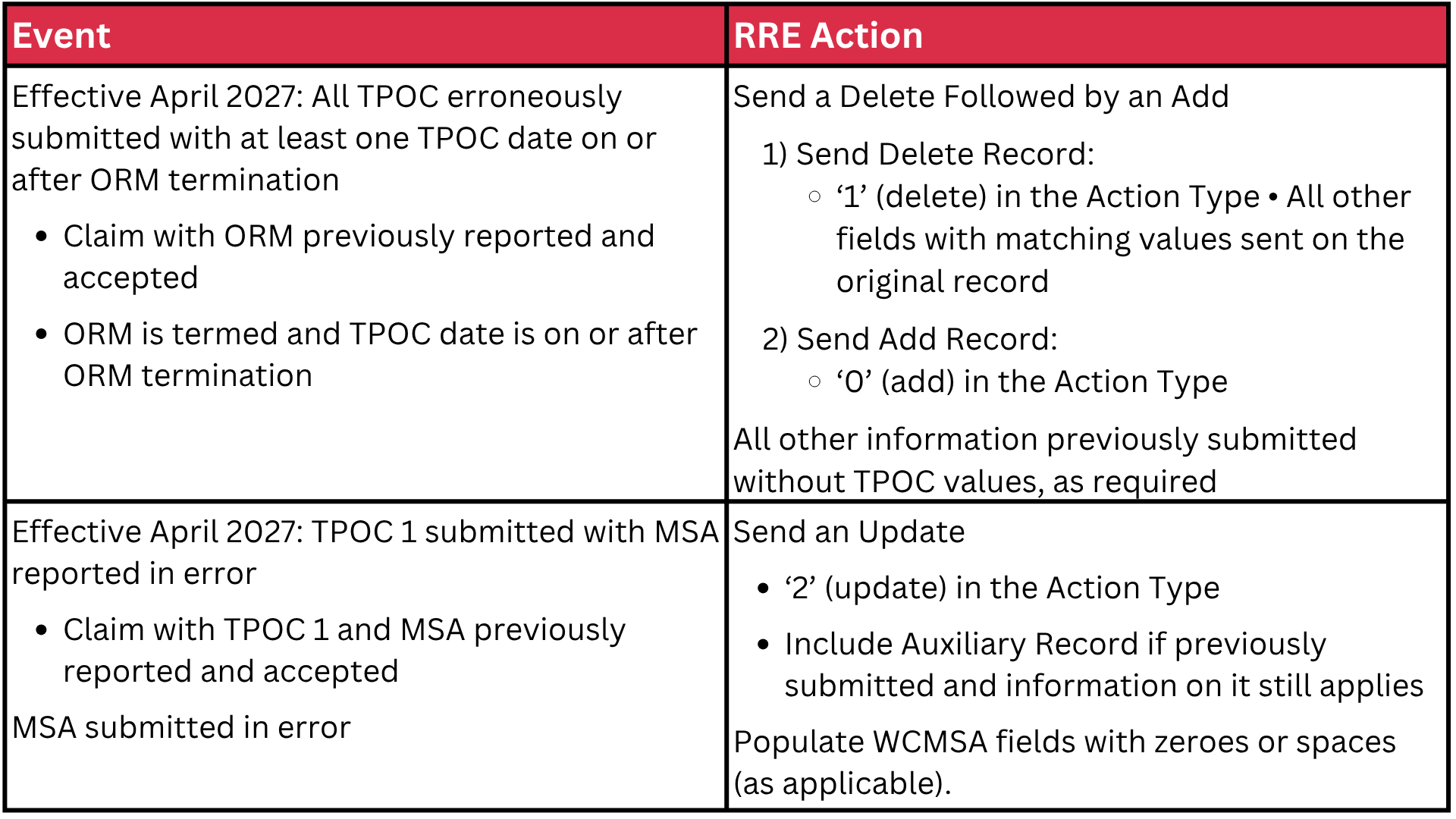
CMS has included new processing logic when TPOC or a WCMSA has been reported in error. This will become effective April 2027. As noted in Chapter IV: Table 6-12: of the Guide, CMS will require zeroes to be placed in these fields when submitting a Claim Input File Detail (or Auxiliary) record.
Claim Input File Submission
The Claim Input File is the data set transmitted from the RRE to the Benefits Coordination & Recovery Center (BCRC) for Section 111 reporting. It is submitted on a quarterly basis during the RRE's assigned file submission period.
If an RRE fails to submit a Claim Input File within a six-month period, a non-submission notification will be sent to the RRE's Authorized Representative and Account Manager.
Final Thoughts
CMS continues to refine the Section 111 Reporting process through both technical and substantive updates. Understanding these changes, big and small, is imperative to a compliant Section 111 Reporting program. However, tracking evolving guidance and interpreting new requirements can be challenging for even the most experienced organizations. At Sanderson Firm, we help RREs work through these complexities through practical guidance, customized training, compliance support, and comprehensive Section 111 reporting services.
For additional information about our Section 111 Reporting offerings or for any of your Medicare Secondary Payer questions, please Contact Us.