Not a Medicare Beneficiary? Think Again: The MSP Risk Hiding in Your Next Settlement
When a workers’ compensation or liability claim involves a Medicare beneficiary, most experienced claims professionals know the drill pursuant to the Medicare Secondary Payer (MSP) statute: Medicare’s interests must be considered before the claim is settled. But what happens when the claimant isn’t a Medicare beneficiary yet? That is where things can get more complicated, and where settlement terms can inadvertently create exposure.
A claimant’s current Medicare status is not necessarily the end of the analysis. Even if an individual is not enrolled in Medicare on the date of settlement, Medicare’s interests may still need to be considered in workers’ compensation cases if the claimant has a reasonable expectation of becoming a Medicare beneficiary within 30 months of settlement. In other words, “not on Medicare” does not necessarily mean “no Medicare issue.”
So, What Exactly Is a “Reasonable Expectation”?
The Centers for Medicare & Medicaid Services (CMS) identifies several circumstances that can indicate an individual has a reasonable expectation of Medicare enrollment within 30 months.
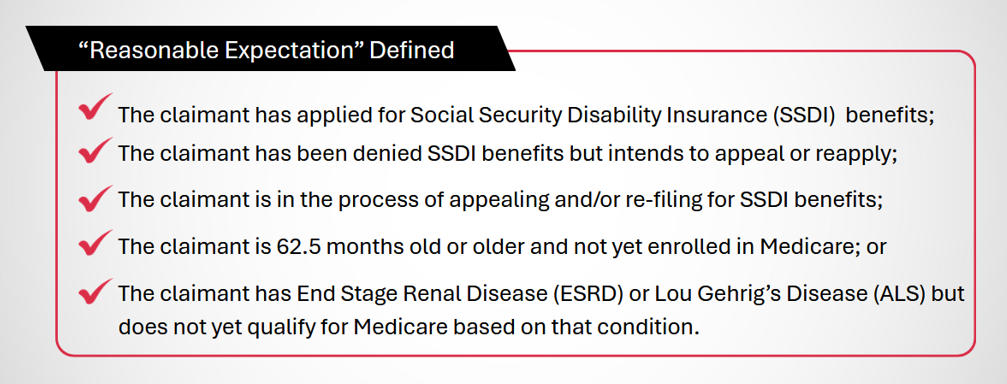
If one of these circumstances exists, the fact the claimant is not currently enrolled in Medicare should not end the MSP analysis for workers’ compensation claims. Instead, the parties should consider Medicare’s potential future interests in the same way they would if the claimant was an existing Medicare beneficiary. And that brings us to one of the most misunderstood areas of MSP compliance: the Medicare Set-Aside (MSA).
For workers’ compensation claims, Medicare’s future interests are addressed through a Workers’ Compensation Medicare Set-Aside Arrangement (WCMSA). The concept is straightforward:

But there is an important distinction that is often lost in the conversation: creating an MSA and submitting an MSA to CMS are two different things.
The MSA Question: Submit It or Don’t?
CMS review of a WCMSA is voluntary. In fact, CMS expressly states in Section 8.0 of its WCMSA Reference Guide:
“There are no statutory or regulatory provisions requiring that you submit a WCMSA amount proposal to CMS for review.”
That means a non-submit MSA can be a perfectly appropriate way for parties to address Medicare’s future interests without seeking CMS approval.
Reasonable Expectation & $250,000 Submission Threshold Confusion
For a claimant who is not yet a Medicare beneficiary but has a reasonable expectation of becoming one within 30 months, CMS has established a $250,000 workload review threshold for WCMSA submissions. This is frequently misunderstood. Some parties assume that if the settlement is below $250,000, there is no need to prepare an MSA. That is not what the threshold means.
The $250,000 figure is a CMS workload review threshold, not a safe harbor from MSP obligations. The distinction matters. If Medicare’s interests need to be considered, settling below the CMS review threshold does not make those obligations disappear. It simply means the parties generally cannot submit the WCMSA to CMS for review under that workload review process.
So, the question should not simply be: “Is the settlement under $250,000?” The better question is: “Have we appropriately considered Medicare’s interests?” That is a much more important compliance question.
What About Liability Claims, Where Things Get Even More Interesting?
Workers’ compensation claims at least have a defined CMS review process for WCMSAs. Liability claims do not. There is currently no comparable CMS review process for Liability Medicare Set-Asides (LMSAs) but that does not mean Medicare’s interests can be ignored. Over the years, CMS has explored creating a more formal regulatory framework for LMSAs. Various proposed rulemakings have been introduced and ultimately withdrawn before being finalized. The result?
The industry is left largely to work within the existing MSP framework, and the guidance CMS has previously provided, including the guidance commonly associated with the 2011 Benson Memo.
When Can a Liability MSA (LMSA) Potentially Be Avoided?
CMS via the Benson Memo provides an important piece of guidance:
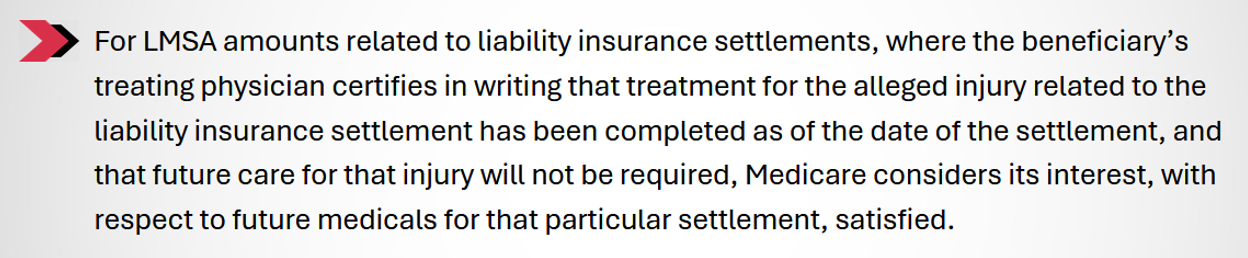
When that certification is obtained, an LMSA may not be necessary to address future medical expenses related to that injury.
But what happens when there is no such certification? That is where the analysis becomes much more fact specific. If the treating physician has not certified that treatment is complete and no future care will be required, parties should consider whether an LMSA is appropriate to account for Medicare’s potential future interests. And importantly, the absence of a formal CMS submission process for LMSAs does not eliminate the underlying MSP obligation.
The Bottom Line: Medicare Status Is Only the Starting Point
The need for MSP compliance cannot always be reduced to the claimant’s Medicare status alone.
The reality is much more nuanced. When settling a workers’ compensation or liability claim, the parties should consider:
· Is the claimant currently a Medicare beneficiary?
· If not, does the workers’ compensation claimant have a reasonable expectation of Medicare enrollment within 30 months?
· What future medical treatment is reasonably anticipated?
· Is an MSA appropriate? And if so, should the MSA be submitted to CMS for review?
· If an MSA is not submitted, how will Medicare’s interests be appropriately documented and protected?
· For liability claims, is there physician certification that future treatment is not required?
The goal isn't simply to get the claim settled. The goal is to settle the claim in a way that accounts for Medicare’s interests and minimizes future exposure for everyone involved. Because the most expensive MSP problem is often the one everyone assumed wasn't a problem in the first place.
Need Help Navigating MSP Analysis?
Sanderson Firm PLLC provides nationwide MSP compliance services to help claims professionals, insurers, employers, attorneys, and other stakeholders navigate Medicare’s interests before a settlement is finalized. Our legal and clinical experts can help determine whether a claimant has a reasonable expectation of Medicare entitlement, whether an MSA should be considered, and what approach makes sense based on the facts of the claim. Have a settlement on your desk that raises an MSP question? Let’s talk.